

New study underscores the importance of a clear definition and joint implementation of platform technology in Europe
New study underscores the importance of a clear definition and joint implementation of platform technology in Europe
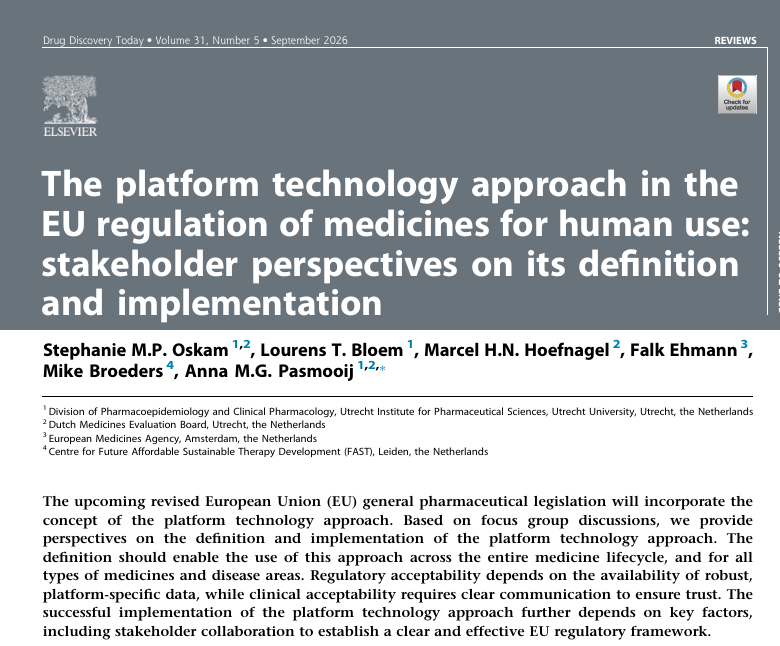
European pharmaceutical legislation is on the verge of a major change. The revised European pharmaceutical legislation will formally incorporate the concept of the platform technology approach. A new study by researchers from Utrecht University and the Netherlands Medicines Evaluation Board (CBG), among others, examined how various stakeholders view the application of platform technology in drug development. The study shows that there is significant potential for improving the reuse of knowledge and processes, but that a clear definition, sound regulatory frameworks, and collaboration are needed for the approach to work in practice. For FAST, the study is primarily an important intermediate step: by identifying different perspectives and outstanding questions, it lays the groundwork for accelerating the further development of definitions, frameworks, and practical applications.
Platform technology makes it possible to (re)use knowledge, processes, and technologies in the development of multiple drugs. This involves, for example, combining a predefined fixed component with a customizable variable component that is tailored to a specific disease or patient group. This can make the development and evaluation of new drugs more efficient and potentially contribute to faster access for patients.
To ensure an effective and future-proof implementation of the platform technology approach within the framework of EU regulations governing human medicines, it is essential to take into account the perspectives of relevant stakeholders. The new study, published in *Drug Discovery Today*, maps out the perspectives of various stakeholders. The researchers organized four focus groups with regulators, representatives of the pharmaceutical industry, nonprofit developers, healthcare professionals, and patients (and their representatives).
From Existing Knowledge to Reusable Knowledge
A key conclusion from the study is that platform technology can have broad applications. The stakeholders involved see opportunities throughout the entire life cycle of a drug and across various types of drugs and disease areas.
In this way, platform technology addresses a fundamental question in drug development: how do we ensure that knowledge that is already available can be reused as effectively as possible?
In this context, some stakeholders also describe platform technology as a potential way to formalize the use of prior knowledge: existing knowledge relevant to the development and evaluation of a new drug. A more structured approach to leveraging such knowledge in research and development contributes to a more efficient system. Stephanie Oskam: “During the focus groups, it became clear that most stakeholders view the platform technology approach as a promising concept. It was made clear that this approach has the potential to accelerate drug development, reduce duplication of effort, and increase efficiency. In addition, it was noted that it could lower costs and the regulatory burden and improve patients’ access to new drugs.”
Not a single type of platform approach, but various applications
At the same time, the study shows that “platform technology” is not a clear-cut concept. It can take various forms and relate to different aspects of drug development and regulation.
A clear and future-proof definition is crucial for the effective implementation of platform technology. A definition that is too narrow may unintentionally exclude new technologies or applications. Conversely, a definition that is too broad may lead to inconsistent interpretation and regulatory uncertainty.
The study helps to make this discussion more concrete. By comparing the various possible applications and perspectives, it provides a better starting point for developing a European definition and for determining the limits and conditions under which platform technology can be applied. The goal is not to immediately lock down the framework completely, but to create sufficient clarity to accelerate its development and application.
In this way, platform technology touches on a broader trend in drug regulation: how can we conduct assessments more intelligently and efficiently without lowering the standards for safety, quality, and efficacy?
For FAST, that distinction is essential. The goal of platform technology should not be to lower the bar, but to make better use of available knowledge and to organize research and evaluation in a way that prevents unnecessary duplication.
Collaboration is a prerequisite for success
The study also makes it clear that successful implementation is not merely a technical or legal challenge. According to the researchers, collaboration among regulators, representatives of the pharmaceutical industry, nonprofit developers, healthcare professionals, and patients (and their representatives) is crucial to establishing a workable European framework.
Communication also plays an important role. It must be clear to patients and healthcare professionals what the use of a platform technology entails—and, above all, what it does not entail. The use of a platform approach must not give the impression that drugs are being evaluated less carefully.
From a promising concept to a workable reality
The study is being published at a crucial moment. European pharmaceutical legislation is currently undergoing revision, and platform technology is an integral part of that process. Even beyond the scope of this study, the topic is receiving increasing attention. In March 2026, the study was highlighted during an EMA webinar on the use of platform approaches in non-clinical and clinical domains. In the Netherlands, too, the topic is being raised with increasing frequency, including during a workshop organized by DARE-NL and at the CBG College Day. These developments underscore that the discussion has now moved beyond the question of whether platform technology has potential. The next step is to determine how this potential can be translated into a workable, predictable, and future-proof European practice. The authors make several recommendations for further implementation, including a clear and flexible definition, clear boundaries and guidelines for application, collaboration among stakeholders, and a focus on ensuring that the concept is understandable to patients and healthcare professionals.
FAST plays a key connecting role here. By bringing together developments from science, regulation, industry, healthcare, and the patient perspective, outstanding questions can be identified sooner and next steps can be better coordinated. This helps accelerate the transition from a promising concept to a workable application. Mike Broeders, FAST: “The value of platform technology lies not only in accelerating development and evaluation. The real question is whether it can also help us avoid unnecessary duplication and give patients faster access to new treatments. This requires clear European guidelines as well as room to learn through practical experience.”
FAST: Connecting Knowledge for Future-Proof Drug Development
As an independent center of expertise, FAST monitors developments in new approaches to drug development, evaluation, and access. Platform technology is a prime example of this: it brings together scientific innovation, regulation, and patient access.
This new study shows that there is broad support for this approach, but also that the next step will be crucial: moving from a promising concept to a predictable, proportionate, and future-proof European system. Read the publication here.