

New Amsterdam UMC Fund Gives a Boost to Drug Repurposing
New Amsterdam UMC Fund Gives a Boost to Drug Repurposing
With a €4 million investment in a new drug repurposing fund, Amsterdam UMC is taking a concrete step toward further developing promising applications for existing drugs. This type of targeted funding can help bridge a funding gap and demonstrates how innovation, a willingness to invest, and social value can go hand in hand.
Promising applications of existing drugs do not automatically reach patients. Although drug repurposing—the development of an existing drug for a new application—potentially offers a shorter and less expensive development process than developing an entirely new drug, funding is often a bottleneck. For traditional life sciences investors, the business case is not always attractive enough to justify taking the necessary risks in the early development phase.
Amsterdam UMC Ventures Holding aims to change that with the new Amsterdam UMC Drug Repurposing Fund. The fund has a total size of €4 million and will invest in an expected nine spin-offs resulting from Amsterdam UMC research over the next seven years. Initial investments will amount to approximately €350,000 per company, with room for follow-on investments. Socially responsible pricing will also be a key focus.
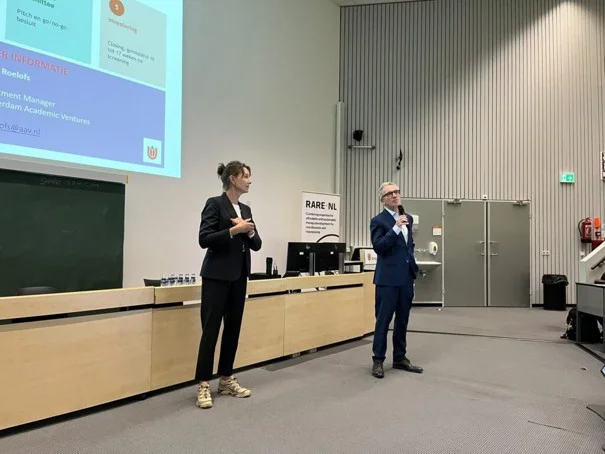
Prof. Dr. Arjen Brussaard, Vice Dean of Commercialization, announced the launch on September 22, 2026, during the RARE-NL event “Drug Repurposing with a Purpose” at Amsterdam UMC: “A good idea shouldn’t be shelved just because it doesn’t fit the traditional investment model. Through this fund, we are promoting the development of new applications for existing medications for patients. This aligns with Amsterdam UMC’s approach to commercialization: for us, social impact goes hand in hand with a willingness to invest.”
Targeted investing in areas where the market has not yet naturally entered
The fund addresses a well-recognized bottleneck in the development of innovative therapies: the transition from promising academic research to further development and application in patients. Development costs may be lower than for a new drug, but further research is still needed to demonstrate efficacy and safety for the new indication. Furthermore, the commercial potential is not always clear.
Targeted funds can make a difference here. With relatively straightforward investments, projects can be advanced that might otherwise remain stuck in the research phase. At the same time, such investments can convince other financiers to get on board, thereby mobilizing additional capital.
The Amsterdam UMC initiative thus demonstrates how university medical centers can play a role not only in advancing scientific knowledge, but also in creating funding opportunities to actually bring that knowledge to patients.
Social Value as the Basis for the Business Case
Drug repurposing offers opportunities to develop new treatment options, including for patients with rare conditions or diseases for which there are still insufficient treatments available. Because a drug has already been developed, some of the existing knowledge about it can be leveraged. This can reduce development costs and time, although this varies by drug and new application.
These characteristics also provide an opportunity to look at the business case from a different perspective. An investment does not have to be attractive solely because of high revenue projections or maximum profit. When the required investment is relatively modest, a financially viable revenue model can go hand in hand with a socially responsible price and sustainable availability for patients.
This does, however, require making informed choices from the very beginning: regarding the development strategy, financing, collaboration with other parties, and the way in which a drug will ultimately become available. Social value and financial feasibility must be considered together in this process.
From Promising Research to Sustainable Application
FAST is committed to accelerating the development of innovative therapies and making them available to patients in a sustainable and affordable manner. Drug repurposing is one of the avenues through which FAST, in collaboration with the RARE-NL hub, is pioneering solutions to bottlenecks and connecting academic researchers, entrepreneurs, investors, and other stakeholders.
The Drug Repurposing Venture Challenge, organized by FAST in collaboration with ZonMw, builds on this. In this challenge, researchers develop their scientific ideas into a well-founded business plan, in which they outline, among other things, the value proposition, risks, financing needs, and development strategy.
Amsterdam UMC’s new fund is a concrete example of how targeted funding can support this development. To effectively advance more promising initiatives, in addition to funding, collaboration, appropriate development pathways, and investors who value both financial returns and social impact are needed.