

PwC: FAST has established a prominent role in Dutch therapy development in a short space of time
PwC: FAST has established a prominent role in Dutch therapy development in a short space of time
From its independent position, FAST connects stakeholders involved in therapy development, supports innovators and helps identify and address barriers. Through the development of four thematic hubs and by promoting knowledge sharing and collaboration, FAST has also contributed to strengthening the Dutch therapy development ecosystem. These are among the findings of a PwC study assessing FAST’s societal impact over the period 2023–2026. According to PwC, the centre of expertise has rapidly established a recognised coordinating role. To preserve and further enhance its long-term societal value, PwC recommends, among other measures, securing sustainable funding and safeguarding FAST’s independence, while further strengthening the network of FAST hubs.
FAST was established in 2023 to support the development of innovative therapies and help create better conditions for affordable and accessible treatments. Commissioned by FAST, PwC assessed the extent to which the centre of expertise is fulfilling its public-interest responsibilities and what results and effects can be observed. As part of the study, PwC analysed available data and documents and interviewed researchers, innovators, representatives of regulatory authorities and industry stakeholders.
From supporting innovators to strengthening the network
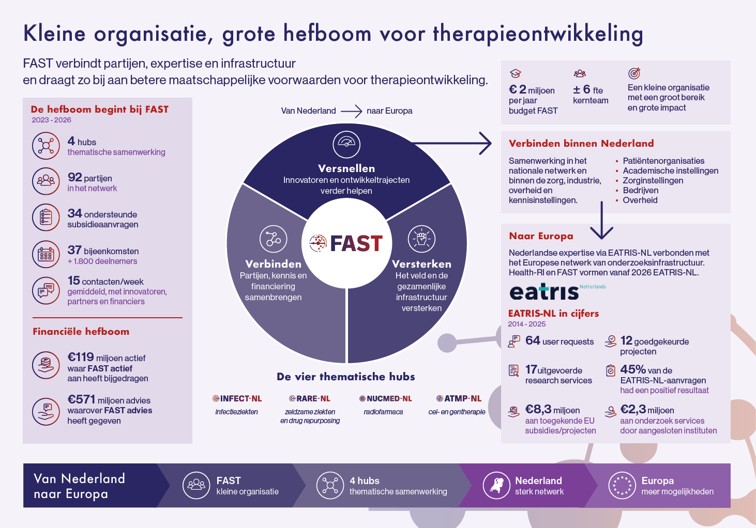
The study shows that FAST contributed to the Dutch therapy development ecosystem in several ways between 2023 and 2026. For example, FAST facilitated the development of four thematic hubs: RARE-NL, InFECT-NL, ATMP-NL and NUCMED-NL. These hubs bring together knowledge, expertise and infrastructure in specific areas of therapy development.
According to PwC, collaboration with EATRIS, the European infrastructure for translational research, also contributes to supporting innovators. Through EATRIS, FAST provides access to international knowledge and expertise. Conversely, innovators approaching EATRIS can be referred to FAST for support with policy, regulatory and funding-related challenges. It is precisely this combination that makes FAST’s position within the international network distinctive.
PwC identifies support for innovators, the promotion of collaboration and the identification of systemic barriers as key elements of FAST’s contribution.
Key results from the analysis include:
- Four thematic FAST hubs established, focusing on rare diseases and drug repurposing, infectious diseases, cell and gene therapies, and radiopharmaceuticals.
- An average of 15 contacts per week with therapy developers through FAST’s guidance and signposting service.
- Eight FAST reports published, including guidance on drug repurposing pathways, the ATMP Handbook, the Guidelines for Socially Responsible Licensing and the Strategic Research Agenda for Targeted Radionuclide Therapy.
- Three serious games developed and three podcast series released, covering drug repurposing, nuclear medicine, and innovation and affordability.
- 34 grant applications supported, of which 13 were successful.
- 37 events organised by FAST and the hubs, attracting approximately 1,800 participants in total.
- Approximately €119 million in funding awarded through grant applications to which FAST actively contributed. In addition, FAST provided advice on applications that secured approximately €571 million in funding.
PwC emphasises that FAST plays a role in mobilising stakeholders and facilitating connections in relation to this funding. The amounts cited do not represent funding received by FAST itself.
Independence as a key success factor
One of the study’s key findings concerns the importance of FAST’s independent, publicly oriented position. According to the stakeholders interviewed, this position enables FAST to bring together organisations with diverse interests, including academic institutions, companies, government bodies, funding organisations and patient organisations.
Combined with its specialist expertise and extensive network, this enables FAST to facilitate collaboration that might not otherwise emerge. PwC describes FAST as a connecting link between practical challenges in therapy development, systemic barriers and collaborative solutions.
The analysis also illustrates how practical experience can contribute to broader systemic change. Examples highlighted by PwC include FAST’s work on drug repurposing, the development of a joint research agenda for radiopharmaceuticals and efforts to address regulatory challenges relating to platform technologies.
Long-term societal impact
PwC sees opportunities for FAST to contribute to faster, more affordable and socially responsible therapy development in the longer term. Ultimately, this could also lead to improved health outcomes and economic value.
At the same time, the study makes an important distinction between the results already observed and longer-term societal impacts. As FAST was only established in 2023 and many development programmes are still at an early stage, outcomes such as improved health and economic growth cannot yet be directly attributed to FAST.
From established value to sustainable impact
In addition to reviewing the results achieved between 2023 and 2026, PwC considers what is needed to preserve and further strengthen FAST’s societal value in the longer term. The study emphasises the importance of securing sustainable funding while safeguarding FAST’s independence. According to the researchers, this independence is a crucial condition for the centre’s effectiveness and legitimacy.
PwC also recommends further developing the four FAST hubs into a more cohesive network, while enabling them to operate largely independently. The analysis therefore not only provides insight into what FAST has achieved in recent years, but also offers recommendations for the continued development of the Dutch therapy development ecosystem.
